Pages

Showing posts with label Duna. Show all posts

Sunday, 14 September 2014

Kerbal Space Program: Duna Aircraft

Mission: Develop an aircraft capable of flight on Duna using experimental technologies.

The experimental version of The Wizard tested on Kerbin.

As a small distraction from science gathering, Mission Control suggested experimenting with building an aircraft using the recently developed fission reactors and thermal turbojets. An aircraft propelled by a thermal turbojet with heat provided by a fission reactor would have the capability of flying without the need of refueling for years -- or centuries if the fission reactor was shut down and allowed to cool between flights. This alone would have made for an interesting challenge; however, living on Duna had instilled dreams of flying on its skies and The Wizard was born of these dreams.

The Wizard was a biplane design with several air intakes to help compensate for the thin atmosphere on Duna. The reactor and turbojet were positioned, unsurprisingly, at the rear of the aircraft. The experimental version of The Wizard performed exceptionally well on Kerbin.

The aircraft separating from its interplanetary transport and entering the Dunian atmosphere.

The (Dunian) Wizard was transported to Duna using rocketry previously used to transport habitation modules. Unfortunately, The Wizard needed to be piloted to Duna by a brave, regrettably nameless Kerbal who was not guaranteed living accommodations on arrival. Nevertheless, the brave Kerbal completed the suicide mission admirably. The aircraft's fission reactor was manually activated before entering the Dunian atmosphere. Mission Control remarked on the aircraft's extreme difficulty in maneuvering at high and medium altitudes where the atmosphere was thin.

The Wizard approaching the Duna Outpost.

Thankfully, the large maria of Duna were of sufficiently low altitude and had thick enough atmosphere to accommodate flight. At under 1500 M The Wizard controlled similar to its performance on Kerbin. The aircraft was flown successfully for approximately 500 KM between the altitudes of 500 M and 1500 M at a speed of 500 M/S. It remains to be seen how well the aircraft operates at higher altitudes outside the Duna Outpost's maria.

The Wizard parked at the Duna Outpost.

Monday, 18 August 2014

Kerbal Space Program: Duna Outpost Improvements and Ike Expedition

Mission: Improve the Duna Outpost's facilities and gather science from Ike.

Airdropping a Duna-Ike spacecraft (foreground) and two rovers (background) near the Duna Outpost.

With life support capabilities successfully installed on Duna, the next phase of Duna-Ike system development was giving the Kerbals mobility in the form of rovers and spacecraft. A very simple wheeled rover and a nuclear-powered spacecraft were designed and transported to Duna. The two rovers and spacecraft were accompanied by kerbalnaut Bill Kerman and airdropped within ten kilometers of the Duna outpost.

Showcasing the improved facilities of the Duna Outpost. In order from left to right: greenhouse, rover, Duna-Ike spacecraft, Kethane module, habitat module.

The rovers were driven and the Duna-Ike Express spacecraft flown to the Duna Outpost and refueled. After the necessary vehicle assessments were performed, Bill Kerman immediately launched for the tidally locked moon Ike. The Duna-Ike Express had been designed to be capable of launching from the surface of Duna, landing on Ike, and returning safely to the surface of Duna. The spacecraft was a resounding success and gathered much science from the moon of Ike. With transportation facilities established, the next phase of development would involve establishing permanent science labs on the planet.

The Duna-Ike Express returning to Duna.

Sunday, 10 August 2014

Kerbal Space Program: Duna Outpost

Mission: Establish a Duna outpost for future missions.

With the installation of new KSP mods requiring life support, the establishment of bases throughout the system would be critical in performing long-term missions with crew. Duna would be the location of our first base and launching point for missions in and near the Duna system.

Satellite used to scan for Kethane and rare metals.

Duna was chosen to be the location of our first proper base, instead one of Kerbin's moons, primarily because of it's thin (although toxic) atmosphere. This atmosphere helps tremendously with heat dissipation and means we need not be concerned with modules overheating. In future missions, after developing newer technologies and acquiring experience, establishing colonies on non-atmospheric planets, such as Dres, would become easier.

The outpost would be required to immediately accomplish two tasks: (1) provide a sustainable habitat for Kerbals and (2) serve as a refueling location for future missions. When developed further, the outpost could be expanded to include permanent science laboratories and rare metal harvesting. The first order of business was to locate Kethane at a low altitude on the equator. An outpost on the equator would reduce the amount of fuel required for interplanetary trips and the low altitude would result in a thicker atmosphere and thereby soften landings using parachutes. A satellite was placed into orbit and such a location was discovered.

The location of Kethane around Duna's equator. Kethane pockets are coloured green. The Duna outpost was placed within the large valley on the equator.

The next step was to transport the outpost modules to Duna. However, we had not yet unlocked the secrets of wheel technology and the modules would need to land with pinpoint accuracy next to each other. This would require hours of simulations (reloading) to have the modules, traveling upwards of 1 km/s, land withing 50 meters of each other. Nonetheless, the modules were put into position and the brave Kerbalnaut Sherlie Kerman emerged from the habitat module to connect modules and activate the greenhouse. The outpost was now operational.

Duna outpost establishment. The outpost is comprised of a habitat module (left), small Kethane extractor and refinery (bottom right), and a greenhouse (top right).

With this small Duna outpost established, our next goal would be to bring a small rocket capable of traveling back and forth from Duna and Ike, Duna's moon, in order to facilitate the collection of more science. A further task would be to bring a wheeled vehicle to explore the Dunian landscape.

Monday, 17 March 2014

Kerbal Space Program: Duna to Kerbin

Mission: Interplanetary Travel from Duna to Kerbin

Top: Planning a course from Duna to Kerbin. Bottom: Departing from Duna.

The Kerbals had been stationed on board the Duna Space Station for a number years and would be needed for future missions. They were beginning to tire of each others company and requested a leave of absence. After much deliberation, Gerlo, Ronmon, and Ribdon were given permission to return home.

The Kerbals boarded the interplanetary vessel and plotted a course for Kerbin. Gerlo transferred sufficient fuel and mono-propellant to the interplanetary craft and Ronmon performed the undocking maneuvers. When the craft was safely distant from the station, the Kerbals activated the nuclear engines and departed from Duna.

Arriving at Kerbin.

This would be the first time in Kerbal history that we attempted to return anything from beyond the Kerbin system. Our scientists informed us that returning would be quite similar to departing, only in reverse, except still in the same direction, while following a completely different trajectory. Maybe it wasn't exactly the same, but we would make it work nonetheless!

Separating the command module from the interplanetary craft.

In a pure stroke of luck, we managed to have the Kerbals arrive somewhat near Kerbin! We discovered that the trip only consumed about 25% percent of the craft's fuel. We decided not to inform the Kerbals aboard the Duna Space Station that a large percentage of their fuel was wasted. Nothing good would come of it!

Ribdon adjusted the craft into an aerocapture with Kerbin. Ronmon separated the command module from the craft and boosted away. The two crafts greatly separated from one another after entering Kerbin's atmosphere. The parachutes were activated and the command module thankfully came to a rest above land!

Top: Entering Kerbin's atmosphere. The interplanetary craft as it burns up can be seen as a tiny speck above and to the left of the command module. Bottom: Parachutes are deployed!

We did it! We had successfully built a space station to orbit around Duna, landed Kerbalkind on both Duna and it's moon, Ike, AND returned the Kerbals (mostly) safe and sound! Where would we go next? The universe was ours to explore!

Here's one for the family!

Thursday, 13 March 2014

Kerbal Space Program: Duna Landing

Mission: Duna Landing

Top-Left: The aerocapture maneuver. Bottom-Left: Parachutes partially deployed during aerocapture. Right: Final descent with parachutes fully deployed and engines activated.

Our mission was a return trip from the surface of Duna back to the Duna Space Station. We evaluated a number of possible landing approaches with simulations and came to the conclusion that the an aerocapture landing would be the best solution. It was also highly desirable to land in sunlight to avoid any nasty creatures that might roam the Dunian surface during the night.

Ronmon, Gerlo, Ribdon boarded the Dunollo 1 lander, refueled, and undocked from the Duna Space Station. Ronmon plotted the aerocapture maneuver, which would have the Kerbals traveling approximately a kilometer a second only ten kilometers above the surface, and Gerlo activated the engines. Shortly thereafter, the Kerbals found themselves cruising through the Dunian atmosphere.

Top-Left: Ike on the Dunian horizon. Top-Right: exiting the Dunallo 1. Bottom: Group photo in front of the Dunollo 1.

Ribdon was reminded to open the parachutes and the crew began their landing procedures. Our simulations, which had resulted in many explosions, suggested that any attempt to fully deploy parachutes at a velocity greater than 500m/s would be disastrous. The aerocapture reduced our velocity sufficient and the Kerbals activated the engines briefly during the final descent to soften the landing. The lander touched down on a small incline with no difficulties whatsoever.


Ronmon communicated the successful landing back to the station and the crew began their science experiments. While this wasn't our first landing on Duna, previous landings had been distant from the equator and the Kerbals were quite curious to determine if the laws of physics still applied to such a strange place. Gerlo was responsible for photographing the landing location and immediately spotted Ike's peculiar geostationary orbit on the horizon. The moon slowly floated over the horizon throughout the day and hid briefly behind at night.

Left: Ascending from Duna. Right: Positioning for orbital maneuvers during ascent. Ike in the background.

Not wanting to be stranded for several decades on a different orbital body, Gerlo insisted the Kerbals return to the station. Ribdon deactivated the main Poodle engine before launch due to it's low atmospheric fuel efficiency and the ascent was achieved using the smaller engines. The ascent was slow, but perfectly executed. Upon reaching vacuum, the Poodle engine was reactivated and the Kerbals rendezvoused with the station.

Top: Planning the rendezvous. Bottom: Docking with the Duna Space Station.

Gerlo boasted to the crew about being the first Kerbal to survive and return from a Duna and Ike landing. The Kerbals aboard the Duna Space Station convinced mission control to return Gerlo to Kerbin for his achievements. They were more interested in enjoying themselves in peace and Gerlo was quite excited to be celebrated back on Kerbin. Plans for an interplanetary mission home were prepared.

Tuesday, 11 March 2014

Kerbal Space Program: Ike Rescue

Mission: Rescue Gerlo Kerman from Ike

Top-Left: Transferring directly from Duna orbit to an Ike orbit. Top-Right: Planning the landing near the stranded Kerbal. Bottom: Landing on Ike in the darkness.

Our mission was to rescue Gerlo Kerman from the surface of Ike after being stranded for several years. After running a handful of simulations, the Kerbals decided an interplanetary tug would be unnecessary to accomplish the rescue. The mission was simple: transfer to Ike, achieve a stable orbit, land a few kilometers away from Gerlo (because landing on a rotating object is tricky!), rescue Gerlo, and head back to the station.

The Dunollo 1 lander was fueled up, remote guidance activated, and undocked from the Duna Space Station. We used our Poodle engine for the entirety of the mission to capitalize on its high fuel efficiency in a vacuum. The lander transferred smoothly to Ike and achieved an orbit without any additional effort. We then had the lander accelerate retrograde to it's orbit to have us in a near-straight descent onto Ike. With adjustments we managed to land within three kilometers of Gerlo's location.

Gerlo Kerman says his goodbyes.

Gerlo Kerman had initially been deployed with our older Lobster model buggy which allowed him drive around the surface of Ike. Unfortunately, the Dunollo 1 landing site was up a mountain from Gerlo and he grew impatient with waiting for the Lobster to climb such heights. Gerlo decided he would capitalize on Ike having no atmosphere and used his jetpack to travel at speeds upwards of 100m/s towards the landing site. He arrived safely at the landing site, said his goodbyes, and prepared to escape Ike.

Launching from Ike.

Gerlo launched straightforwardly from Ike and obtained an orbit around the moon. The Kerbals at mission control calculated the appropriate ejection angle which would transfer Gerlo to an orbit around Duna. Gerlo performed the maneuver and followed up with an orbital rendezvous with the Duna Space Station.

Left: Arriving at Duna. Right: Approaching the Duna Space Station.

The Kerbals again became aware of the terrible arrangement of thrusters on the Dunollo 1 which made docking immensely stressful. They concluded that any future Dunollo 2 lander design would have at least eight thrusters instead of four. Most of which in the proper locations! Regardless, Gerlo arrived home at the station safely and was reunited with the Kerbals he hadn't seen in several years. After a short violent outburst of frustration over being abandoned on a desolate moon for nearly a decade, Gerlo was convinced that damaging the station wouldn't be in his best interests. The Kerbals would spend the next few days relaxing and enjoying the view over Duna.


Thursday, 6 March 2014

Kerbal Space Program: Duna Space Station

Kerbal Space Program

Kerbin: Earth Analog
Kerbals: Humankind Analog
Duna : Mars Analog
Ike : Duna's Moon

The existing infrastructure of our Duna Space Station was lacking and needed improvements. The station also needed an orbital adjustment to place it over Duna's equator and such a maneuver would consume nearly all of our fuel; thereby putting an end to any additional Duna missions. We decided to construct a large fueler which would replace the existing station's engines and increase it's fuel capacity. We would attempt bring as much fuel as possible to enable future Duna missions.

Construction of the Duna fueler.

We began construction of the fueler in low Kerbin orbit. The craft consisted of seven separate parts which were docked individually through six orbital rendezvous. We fitted the craft with three large fuel tanks, three smaller tanks which would be used during the Duna transfer, and twelve nuclear engines. The Kerbals constructed an interplanetary vessel which would be used to eventually return a handful of Kerbals from Duna. The interplanetary craft was docked to the front of the fueler.

The finished Duna fueler.

In the meantime, we had the Kerbals aboard the Duna Space Station adjust their orbital plane such that it matched Ike's. This orbit would position us over Duna's equator and would simplify the orbital rendezvous of landing craft returning to the station. Additionally, it would greatly simplify transfers to Ike as we would need no orbital adjustments. We might even be able to rescue the poor Kerbal who has been stranded on Ike for several years!

Top-Left & Top-Right: Adjusting our terrible Duna Space Station orbit. Bottom: The Duna Space Station.

We calculated the transfer window and ejection angle and waited for the appropriate opportunity to move the fueler to Duna. Although we had twelve nuclear engines, we missed our first opportunity to have an appropriate ejection angle. Consequently, we waited for the next orbit around Kerbin and ejected appropriately.

Top-Left: Planning the transfer from Kerbin to Duna. Top-Right: Planning the ejection angle. Bottom: The fueler in action.

We encountered Duna with no difficulties. We planned a transfer that would give us a smooth Duna encounter, slightly adjusted our orbital plane to match Duna's, and waited until we arrived at our periapsis with Duna. The Kerbals instructed the craft to burn retrograde until we would experience an encounter with Ike. We performed a gravity assist maneuver with Ike to decelerate and achieve a desirable orbit with Duna. We then performed multiple aerobrake maneuvers to acquire an orbit that was comparable to the Duna Space Station and would allow for an orbital rendezvous.

Top-Left & Top-Right: Gravity assist with Ike to decelerate. Bottom-Left & Bottom-Right: Aerobraking with Duna.

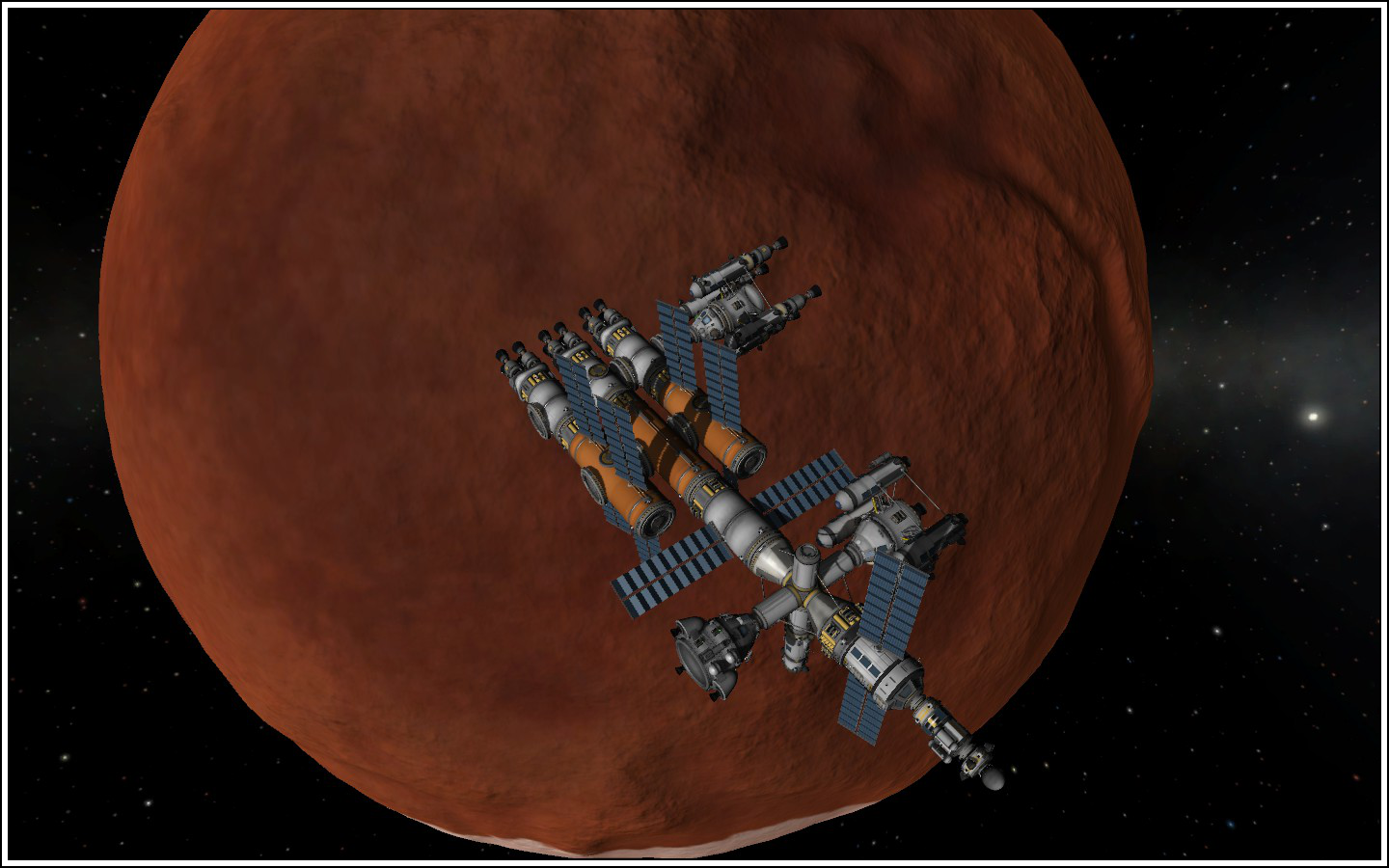
We rendezvoused with the Duna Space Station and began the low-orbit constructions. We detached the engine module from the station and, likewise, we detached the the interplanetary craft from the fueler. In an extremely careful procedure, the Kerbals docked the fueler with the station. The interplanetary craft was attached securely to the side of the fueler module and the existing engine module was left to float forever in the vacuum of space.

Various stages of low-orbit construction of the Duna Space Station. Unfortunately during the night above Duna!

The Kerbals celebrated the success of the mission! The Duna Space Station now had an appropriate orbit, a reasonable amount of fuel, and an interplanetary craft capable of returning home to Kerbin. We were prepared for many future missions.

Our next mission would likely be an Ike rescue mission. We have a Kerbal who has been stranded on Ike for a number of years and has run out of science to do. The Kerbals believe we should be able to use our interplanetary craft as a space tug. We could tug our smaller landing craft to Ike, land on Ike, rescue the Kerbal, launch and rendezvous with the tug, and have the rug return the landing craft to the station (in a manner very similar to the Apollo 11 landing!). The would be the plan anyways!

The complete Duna Space Station with various spacecraft attached.